Showing posts with label Communion. Show all posts

Monday, March 1, 2021

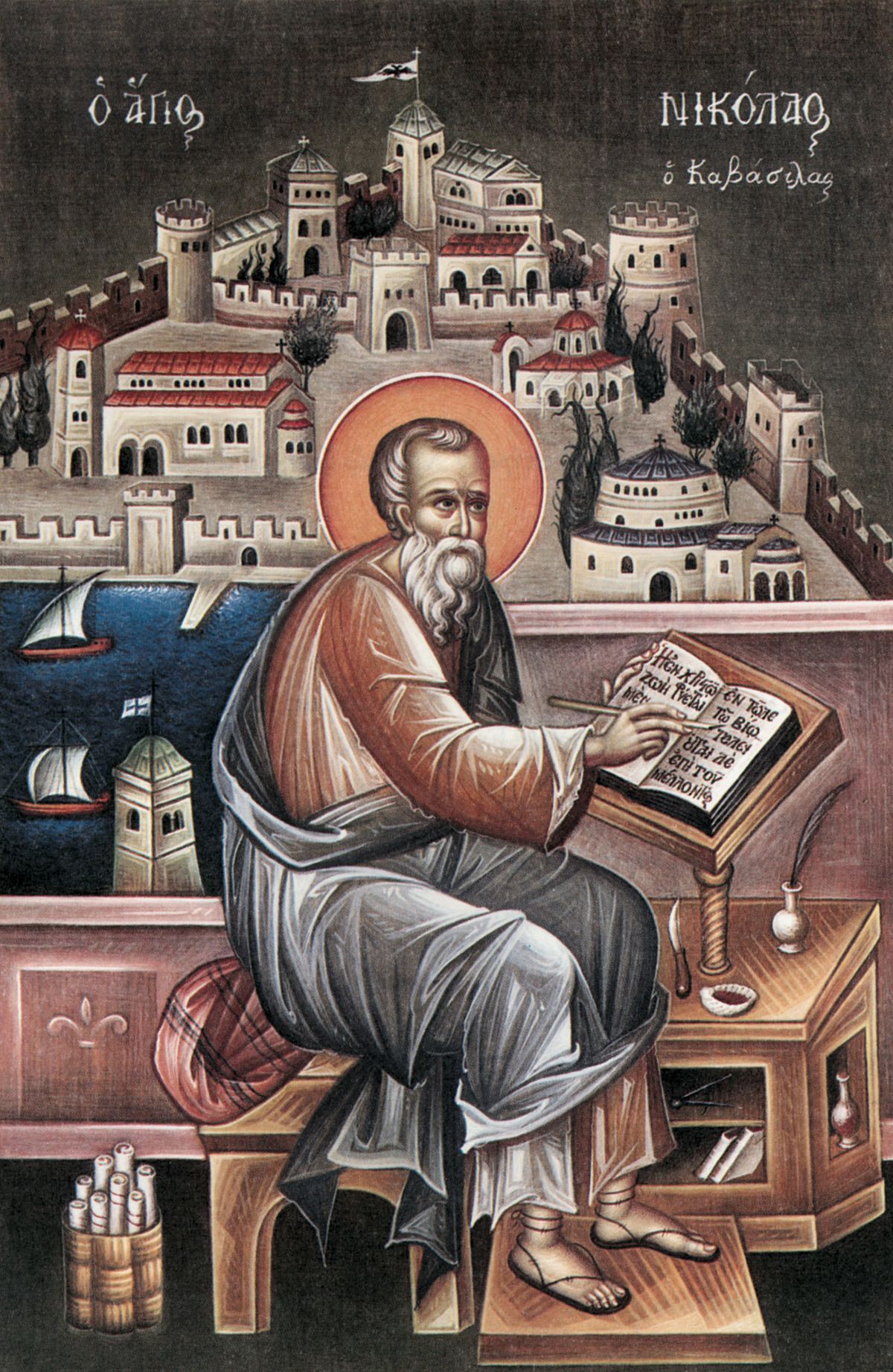
St. Nicholas Cabasilas: on the reality of our adoption as sons of God


 This is the reality of our adoption as sons of God. Unlike human adoptions, it does not consist in the mere name, nor does it confer honor merely to the extent that those who have been adopted share the name of those who have been naturally born and have the same father as they, without having undergone the same birth and its pangs. In this case, however, there is a real birth and a sharing with the only-begotten Son not of the surname only, but of His very Being, His Blood, His Body, His Life. What, then, is greater than that the Father of the only-begotten Son Himself recognizes in us His members and finds the very form of the Son in our faces? It says, "He predestined them to be conformed to the image of His Son" (Rom 8:29).
+St. Nicholas Cabasilas, from The Life in Christ, book 4, #9. How the Eucharist makes us sons of God.

Tuesday, January 12, 2021

Hieromonk Gregorios of Koutloumousiou: The Eucharist as living in Christ


 Between the first visitation of the Word and His Second Coming, there is the present age. We Christians struggle to love the Lord, because love helps us to live the mystery of His visitation. "If a man loves me, he will keep my word, and my Father will love him, and we will come to him and make our home with him" (John 14:23). Love perpetuates God's visitation and transforms man into a dwelling-place of God and a dweller in God: "God is love, and he who abides in love abides in God, and God abides in Him" (1 John 4:16). When we participate in the Mystery of divine love - in the Eucharist and Holy Communion - we are celebrating the Mystery of God's visitation in the world and in our lives. As Christ says: "He who eats my flesh and drinks my blood abides in me, and I in him" (John 6:56).
+Hieromonk Gregorios of Koutloumousiou, from The Divine Liturgy, a Commentary in the Light of the Fathers, Chapter 6 Diptychs and Prayers, Visit us, O God.

Thursday, November 19, 2020

St. Nicholas Cabasilas: The fruits of the Sacraments


 We depart from this water [of Baptism] without sin. Because of the Chrism we partake of His graces, and because of the banquet [of the Holy Eucharist] we live with the same life as He does. in the world to come we shall be gods with God, fellow-heirs with Him of the same riches, reigning with Him in the same kingdom - that is, unless we of our own free will bling ourselves in this life and rend asunder the royal garment. This alone we contribute to the life - that we submit to His gifts, retain His grace, and do not reject the crown which God by many toils and labors has prepared for us.
+St. Nicholas Cabasilas, from The Life in Christ, book 1, #11.

Friday, November 13, 2020

Hieromonk Gregorios: On how to rightly receive the Holy Eucharist


 Every Christian should imitate Joseph, who "took the Body of Jesus, wrapped it in a clean winding sheet and placed it in a new tomb" (cf. Matt 27:59-60) - which is to say, in a new person. Let each one of us therefore take diligent care not to sin, so as not to show contempt for God who dwells within us and expel Him from our soul. The soul of every Christian believer becomes a "new tomb" which will receive the all-holy Body of Christ.
+Hieromonk Gregorios, from The Divine Liturgy a commentary in the light of the Fathers, chapter 3 The Litany and the Great Entrance.

Sunday, November 8, 2020

St. John Chrysostom: On the Reception of the Holy Eucharist


 What is the Bread? The Body of Christ. And what do those who partake of it become? The Body of Christ. Not several bodies, but one body. Just as the bread, while it is made up of many grains, is one bread, so that the grains are nowhere apparent, even though they are there... in the same way, we are united with each other and with Christ. For it is not that you are nourished by one body, and the other person by another; we are all nourished by the same Body. That is why St. Paul adds, "For we all partake of the one bread" (1 Cor 10:17).
+St. John Chrysostom, from Homily 24 on 1st Corinthians, #2.

Sunday, November 1, 2020

St. John Chrysostom: On how to approach the Holy Gifts


 Having taken account of the magnitude of the Sacrifice, make your body beautiful. Understand what your hand receives, and never raise that hand to strike someone... Bear in mind that you do not receive Christ in your hand only but also put Him into your mouth, and keep your tongue pure of foul and abusive language, free from blasphemies and perjury... When you recall that your heart receives that terrible Mystery, never scheme against your neighbor but keep your heart pure of any wickedness. In this way you will also be able to guard your eyes and your hearing... You are invited to a wedding my beloved; do not go in wearing dirty clothes, but provide yourself with the appropriate garment (cf Matt 22:2-14).
+St. John Chrysostom, from Baptismal Instructions, 2.2.

Saturday, September 26, 2020

Hieromonk Moses of Mount Athos: Prayer and the Sacraments


 As there is no healthy plant without roots, there can be no life of prayer without the sacraments, especially Holy Eucharist. For, as Abba Apollos says, "He who withdraws from communing the Sacred Mysteries, causes God Himself to withdraw from him." It is customary for monks to complete prayers begun in their cell when they have gathered in church. And common prayers started in church are completed in their cells. The sacrament of the Holy Eucharist, in which they participated during the Divine Liturgy is continued on the sacred altar of their hearts with ongoing prayer.
+Hieromonk Moses of Mount Athos, from Athonite Flowers, The Life of Prayer.

Saturday, August 22, 2020

St. John of Kronstadt: How long before we become one body?

How long will it be before the Holy Mysteries of which we partake remind us that "we, being many... are one body"; and how long will there be no mutual hearty union between us, as members of the single Body of Christ? How long shall we make our own laws of life, be inimical to each other, envy each other, torment, grieve, fret, judge and abuse each other? When will the Spirit of Christ abide in us, the spirit of meekness, humility, kindness, love unfeigned, self-denial, patience, chastity, abstinence, simplicity and sincerity, contempt for earthly things and entire aspiration after heavenly ones? Lord Jesus Christ! Enlighten our spiritual vision and "let Thy loving Spirit lead" us all "into the land of righteousness." Give us Thy Spirit!
+St. John of Kronstadt, from A Treasury of Russian Spirituality by George Fedotov, section on Preparation for Holy Communion

Monday, July 27, 2020

St. Nikolai Velimirovich: Love and Joy

The holy king David never saw Christ, nor did he ever partake of Christ through Holy Communion, but only felt a prophetic premonition of His coming into the world. Yet even this mere premonition filled his heart with such joy that with all his strength he danced and leapt for joy (2 Sam 6:14-15). And how much more ought we, dear sisters! How much more ought we to dance for joy, since we were deemed worthy to be born not in the time of the Old Testament, but of the New Testament - and not only to hear about the Savior, the Son of God, but even to eat His body and drink His blood, and to receive Him into our heart and to give our heart to Him - with love, love, and more love; with joy, joy, and more joy.
+St. Nikolai Velimirovich, from The Wise Abbess of Ljubljana, #5, in The Struggle for Faith and other writings of Bishop Nikolai Velimirovich and Archimandrite Justin Popovich

Thursday, July 23, 2020

Blessed Theophylact of Ochrid: On the nature of the Holy Eucharist

John 6:56-58: "He that eateth My flesh, and drinketh My blood, dwelleth in Me, and I in him. As the living Father hath sent Me, and I live by the Father: so he that eateth Me, even he shall live by Me. This is that bread which came down from heaven: not as your fathers did eat manna in the wilderness, and are dead: he that eateth of this bread shall live for ever." Here we learn more about the sacrament of Communion. He who eats and drinks of the Lord's flesh and blood dwells in the Lord Himself, and the Lord in him. A strange and marvelous intermingling occurs, such that God is in us, and we in God. Is not this frightful to hear? We do not consume God in His essence. He is intangible and bodiless, and we cannot take hold of Him with our teeth any more than we can apprehend Him with eyes. Neither do we consume the flesh of a mere man, which would bring us no benefit. But since God has united flesh to Himself by an ineffable union, even His flesh becomes life-creating. But His flesh has not changed into the nature of God. Far from it! Just as red-hot iron manifests the energy of fire while remaining iron, so Christ's flesh is life-creating - imparting the divine energy of God the Word - without ceasing to be human.
+Blessed Theophylact of Ochrid1, from The Explanation of the Holy Gospel according to John, chapter 6.
1Theophylact is commemorated as a saint by the Serbian Church. Here we use the more common appellation "blessed".

Sunday, June 21, 2020

St. Nicodemus the Hagiorite: On Frequent Communion

I want to ask you this: If at the time of the Mystical Supper one of the Apostles said: "I do not want to receive Communion today," what would the Lord have said? Certainly, I believe that just as He said to Peter at the sacred washing of the feet, "If Is wash thee not, thou hast no part with Me" (John 13:8), He would likewise have said to one not wanting to receive Communion at the Divine Supper, "If thou dost not eat My body, and if thou dost not drink My blood, thou hast no part with Me."
Beloved, the Lord says this very same thing to us now at every Liturgy: "Except ye eat the flesh of the Son of  Man... ye have no life in you" (John 6:53).
+St. Nicodemus the Hagiorite, from Concerning Frequent Communion of the Immaculate Mysteries of Christ, Epilogue