Showing posts with label God's Indwelling. Show all posts

Friday, February 12, 2021

St. Nicodemus the Hagiorite: Acquisition and Loss of Grace in Baptism


 No sooner are we baptized than the soul shines brighter than the sun, being purified by the Holy Spirit. And not only to we see the glory of God but we also receive from it a certain splendor just as a piece of silver in the rays of the sun reflects those very rays which it receives. But what a pity! It is only right to sigh here bitterly! For this glory which is ineffable and awesome remains within us only one or two days.1 For we extinguish it, being led astray by the winter of worldly cares, the dense clouds of which block out its rays. For the care pertaining to living are indeed a heavy winter and even more sullen than winter.
+St. Nicodemus the Hagiorite, from A Handbook of Spiritual Counsel, Chapter 1, The Attributes of the Mind and the Body
1At the time this was written, most people were still being baptized as adults.

Thursday, February 4, 2021

Fr. Michael Shanbour: Understanding God's Grace


 If we desire to feel the warmth of the sun, we must make the physical effort to walk outdoors and expose our skin to its rays, perhaps shedding some of our clothing. After being tanned by the sun’s rays, we would claim not that our tan came about as the result of our own power, but rather that we desired it and put ourselves in a position to receive it. 
And if there are clouds covering the sun, we do not say, “The sun is angry With me.” The sun has not changed in any way, nor have the sun’s rays ceased to shine. Rather, we acknowledge that the clouds are obstructing the sun’s light and power, keeping it from having its natural impact.
The same is true in the spiritual life. If we desire to be in the presence of the spiritual Sun, we Will adopt a Way of life that naturally exposes us to the rays of God’s grace. This is the way of love or of keeping the commandments of God - “If you love Me, keep My commandments” (John 14:15). It will not be our effort, our works, that save us, but the grace of God, which brings us into union and communion with Him.
+Fr. Michael Shanbour, from Know the Faith: A Handbook for Orthodox Christians and Inquirers, Chapter 2, Grace


Sunday, December 6, 2020

Elder Aimilianos of Simonopetra: Christ in the midst


 What, then, is our gathering together in the Liturgy, our membership in the Church? When two or three of you are gathered together, you can become Christ, because "where two or three are gathered in My name, I am there in the midst of them" (Mt 18:20). It doesn't have the sense of some fourth person joining us, but signifies who we are together, it is what we become when we are together, because in the midst of you, where you are, is Christ. So you cease to be yourselves and together become Christ.
+Elder Aimilianos of Simonopetra, from The Way of the Spirit, Reflections on Life in God, Chapter 6 Awaiting Pentecost

Friday, November 20, 2020

Matthew the Poor: The presence of Christ in our hearts


 Perhaps one of the greatest gifts that have been granted us in the name of Christ is His permanent presence in our hearts. Such presence always accompanies the bearing of our own cross. Whenever man rests under the shade of the Cross, the person of Christ is immediately revealed to him inwardly. The more the joy with which we cope with hardships, the more the clearness of the vision in which the light of Christ’s presence is uncovered within our heart.
+Matthew the Poor, from Sojourners, Monastic Letters and Spiritual Teachings from the Desert, #22 All the Fullness of Gifts in Christ


Wednesday, November 11, 2020

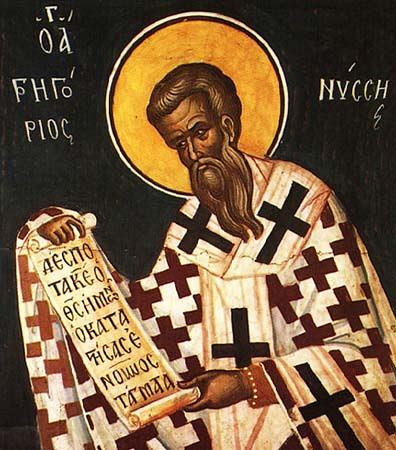
St. Gregory of Nyssa: On our image and likeness to God


 Being like the divine is not our function, for is it the product of human ability, but it is part of the generosity of God who freely, at the birth of the first man, gave our nature a likeness to Himself.
The human effort extends only to this: the removal of the filth which has accumulated through evil and the3 brining to light again the beauty in the soul which we had covered over. It is such a dogma that I think the Lord is teaching in the Gospel to those who are able to hear wisdom when it is mysteriously spoken: "The kingdom of God is within you" (Luke 17:21). This saying shows, I believe, that the goodness of God is not separated from our nature, or far away from those who choose to seek it, but it is ever present in each individual, unknown and forgotten when one is choked by the cares and pleasures of life, but discovered again when we turn our attention back to it.
+St. Gregory of Nyssa, from Ascetical Works, On Virginity.

Sunday, November 8, 2020

St. John Chrysostom: On the Reception of the Holy Eucharist


 What is the Bread? The Body of Christ. And what do those who partake of it become? The Body of Christ. Not several bodies, but one body. Just as the bread, while it is made up of many grains, is one bread, so that the grains are nowhere apparent, even though they are there... in the same way, we are united with each other and with Christ. For it is not that you are nourished by one body, and the other person by another; we are all nourished by the same Body. That is why St. Paul adds, "For we all partake of the one bread" (1 Cor 10:17).
+St. John Chrysostom, from Homily 24 on 1st Corinthians, #2.

Wednesday, September 30, 2020

Hieromonk Gregorios of Koutloumousiou: God's union with us


 On another occasion, St. John [Chrysostom] hears Christ speaking to him: "I am not simply joined with you; I am interwoven, I am eaten, I am attenuated little by little so that the mixing, the interweaving and the union can be greater. For things that are joined preserve their own boundaries, whereas I am interwoven with you. I do not want there to be anything between us. I want the two of be one" (On 1 Timothy 15 #4). Between Christ and the Christian there is no longer anything intervening. Everything dissolves in the light of His love: "We and Christ are one"(On Hebrews 7 #3).
Only a saint can speak this boldly. And that was how the saints [Symeon the New Theologian] did indeed speak:

We become Christ's limbs, and our limbs become Christ:
though I am a wretched man, my hand is Christ, my foot also is Christ.
though I am wretch, I am both Christ's hand and Christ's foot.(Hymn 15)

The words of the saints are not well-turned phrases designed to impress us; they are the outpouring of hearts that overflow with Christ. Amidst this overflowing of Life and Light, the whole man flashes like lightning. All his limbs radiate light. and the world in which the saint lives and moves is full of the light of Christ. The light of Christ illumines all" (Presanctified Liturgy).
+Hieromonk Gregorios of Koutloumousiou, from The Divine Liturgy, A Commentary in the Light of the Fathers, Introduction

Tuesday, September 29, 2020

St. Maximos the Confessor: God's dwelling in our heart


 He who has made his heart pure will not only know the inner essences of what is sequent to God and dependent on Him but, after passing through all of them, he will in some measure see God Himself, which is the supreme consummation of all blessings. When God comes to dwell in such a heart, He honors it by engraving His own letters on it through the Holy Spirit, just as He did on the Mosaic tables (cf Ex 31:18). This He does according to the degree to which the heart, through practice of the virtues and contemplation, has devoted itself to the admonition which bids us, in a mystical sense, "Be fruitful and multiply" (Gen 35:11).
A pure heart is perhaps one which has no natural propulsion towards anything in any manner whatsoever. When in its extreme simplicity such a heart has become like a writing-tablet beautifully smoothed and polished, God come to dwell in it and writes there His own laws.
+St. Maximos the Confessor, from Second Century on Theology, #80-81, in The Philokalia, Volume 2.