Showing posts with label Sin (overcome by Christ). Show all posts

Friday, April 9, 2021

Fr. Stanley Harakas: We are united with Christ in the Divine Liturgy


The Divine Liturgy... becomes the location where we are at the most intense level united with Christ and growing in the image and likeness of God. It is the place of "remembering" and actually sharing in the redemptive Sacrifice of Christ on the Cross, as well as His whole incarnate life. It is that action which most of all characterizes us as the Church, emphasizing our real existence as members of God's Kingdom, beginning in this life and extending into eternity. It is the location where time past, time present, and time future are gathered up for us in ultimate meaning and significance.
+Fr. Stanley Harakas, from Living the Liturgy, Chapter 1, Liturgical Living

Sunday, April 4, 2021

St. Tikhon of Zadonsk: Learn the sickness of Anger


 And see what anger can do in a man; how indignant and noisy he becomes, how he swears, how he beats his head, trembling as in a fever... Man, learn the sickness of thy soul, for without acknowledgment of illness there is no healing... Christ alone can heal us, who sigh and pray to Him with faith.
+St. Tikhon of Zadonsk, from Works, quoted in Saint Tikhon of Zadonsk, Inspirer of Dostoevsky, by Nadejda Gorodetzky

Saturday, October 10, 2020

St. Peter of Damascus: That one should not despair


 Even if you are not what you should be, you should not despair. It is bad enough that you have sinned; why in addition do you wrong God by regarding Him in your ignorance to be powerless? Is He, who for your sake created the great universe that you behold, incapable of saving your soul? And if you say that this fact, as well as His incarnation, only makes your condemnation worse, then repent; and He will receive your repentance as He accepted that of the prodigal son (cf Luke 15:20) and the prostitute (cf Luke 7:37-50). But if repentance is too much for you, and you sin out of habit even when you do not want to, show humility like the publican (cf Luke 18:13): this is enough to ensure your salvation. For he who sins without repenting, yet does not despair, must of necessity regard himself as the lowest of creatures, and will not dare to judge or censure anyone. Rather, he will marvel at God's compassion, and will be full of gratitude towards his Benefactor, and so may receive many other blessings as well. Even if he subject to the devil in that he sins, yet from fear of God he disobeys the enemy when the latter tries to make him despair. Because of this he has his portion with God, for he is grateful, gives thanks and is patient, fears God, does not judge so that he may not be judged. All these are crucial qualities. It is as St. John Chrysostom says about Gehenna: it is almost of greater benefit to us than the kingdom of heaven, since because of it many may enter the kingdom of heaven, while few enter for the sake of the kingdom itself; and if they do enter it, it is by virtue of God's compassion. Gehenna pursues us with fear, the kingdom embraces us with love, and through them both we are saved by God's grace.
+St. Peter of Damascus, from The Philokalia, Volume 3

Friday, August 28, 2020

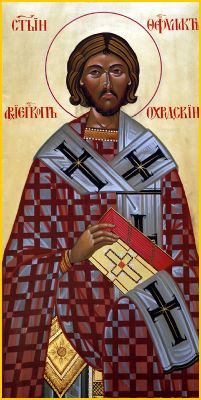
Blessed Theophylact of Ochrid: On the Lamb of God

"The next day John seeth Jesus coming unto him, and saith, 'Behold the Lamb of God, that taketh away the sins of the world.'" (John 1:29).
He did not say "a lamb," but the lamb for there were many lambs, just as there were many "christs" [anointed ones]. But this is the true Lamb, prefigures by Moses and foretold by Isaiah. (cf Ex 12:21-22, Is 53:4-12) Christ is called the Lamb of God because it is God Who accepts Christ's death for our salvation, and also because it is God Who delivers Christ to death for our sake.... John did not say, "that took away the sin of the world," but, that taketh. He takes away our sins every day, some through Baptism and others through repentance. The lambs slain in the Old Testament could not completely wipe out the sins of even one person; this Lamb wipes out the sin of the whole world.... The sin of the world means universal disobedience: this the Lord completely removed, healing the disobedience of mankind by Himself becoming obedient unto death (Phil 2:8).
+Blessed Theophylact of Ochrid1, from The Explanation of the Holy Gospel according to John, commentary on John 1:29

1Theophylact is commemorated as a saint by the Serbian Church. Here we use the more common appellation "blessed".