Showing posts with label Baptism. Show all posts

Friday, April 2, 2021

St. Diadochus of Photiki: On Baptism and the Remembrance of God


 Before holy baptism grace encourages the soul towards good from the outside, while Satan lurks in its depths, trying to block all the intellect's ways of approach to the divine. But from the moment that we are reborn through Baptism, the demon is outside, grace is within...
It is a mark of one who truly loves holiness that he continually burns up what is worldly in his heart through practicing the remembrance of God, so that little by little evil is consumed in the fire of this remembrance and his soul completely recovers its natural brilliance with still greater glory.
+St. Diadochus of Photiki, from One Hundred Texts on Spiritual Knowledge and Discernment, The Philokalia, Volume 1

Friday, February 19, 2021

St. Nikolai Velimirovich


 Only he can be born again in this life who has died to the old man; or, in other words, in whom the old, sinful man is dead. He who immerses himself with his sins, in the water comes up cleansed of sin. He who submits his body, as a bodily man, comes up by the Spirit as a spiritual man. He who buries himself with Christ by baptism as in the grave, rises with Christ in His Resurrection (cf. Col 2:12). He who drowns pride, disobedience, selfishness and all the impurity of the old, sinful man will come out of the water with humility, meekness, obedience and love. He who dies to self will live to God (cf. Rom 6:3-8).
+St. Nikolai Velimirovich, from Homilies volume 1, 7. The Theophany of the Lord.

Friday, February 12, 2021

St. Nicodemus the Hagiorite: Acquisition and Loss of Grace in Baptism


 No sooner are we baptized than the soul shines brighter than the sun, being purified by the Holy Spirit. And not only to we see the glory of God but we also receive from it a certain splendor just as a piece of silver in the rays of the sun reflects those very rays which it receives. But what a pity! It is only right to sigh here bitterly! For this glory which is ineffable and awesome remains within us only one or two days.1 For we extinguish it, being led astray by the winter of worldly cares, the dense clouds of which block out its rays. For the care pertaining to living are indeed a heavy winter and even more sullen than winter.
+St. Nicodemus the Hagiorite, from A Handbook of Spiritual Counsel, Chapter 1, The Attributes of the Mind and the Body
1At the time this was written, most people were still being baptized as adults.

Sunday, January 31, 2021

St. Ignatius Brianchaninov: On Increasing the Grace of Baptism


 These are the means to increase the grace of baptism to boundless measure, inconceivable and implausible to the human mind in its fallen state:
  1. Living by the commandments of the Gospel
  2. Contemplating our own fallen nature
  3. Contemplating the endless greatness and perfection of God
  4. Comparing human nature - worthless in its limitations - with the limitless nature of God
  5. Contemplating the consequences of Adam's sin and the consequences of our own sinfulness
  6. Sorrowing over our calamitous spiritual state and that of all mankind
  7. Enduring all personal troubles patiently.
The increase of the holy spiritual gift given by baptism is just as boundless as the gift given by God from His divine nature is boundless (see 2 Peter 1:4). This cultivation of the gift will overwhelm the entire being of a Christian. When we see this spiritual cultivation in the chosen vessels of God, then the effect of holy baptism on man, expressed by Christ in the parables of the Gospel, becomes completely obvious.
+St. Ignatius Brianchaninov, from The Refuge: Anchoring the Soul in God, Chapter 11, The Various States of Human Nature in Relation to Good and Evil.

Saturday, December 19, 2020

St. John Chrysostom: On the Mystery of Baptism


What then is the use of the water [of Baptism]? This too I will tell you hereafter, when I reveal to you the hidden mystery. There are also other points of mystical teaching connected with the matter, but for the present I will mention to you one out of many. What is this one? In Baptism are fulfilled the pledges of our covenant with God; burial and death, resurrection and life; and these take place all at once. For when we immerse our heads in the water, the old man is buried as in a tomb below, and wholly sunk forever; then as we raise them again, the new man rises in its stead. As it is easy for us to dip and to lift our heads again, so it is easy for God to bury the old man, and to show forth the new. And this is done thrice, that you may learn that the power of the Father, the Son, and the Holy Ghost fulfills all this. To show that what we say is no conjecture, hear Paul saying, "We are buried with Him by Baptism into death": and again, "Our old man is crucified with Him": and again, "We have been planted together in the likeness of His death." ( Rom 6:4, 5, 6). And not only is Baptism called a "cross," but the "cross" is called "Baptism." "With the Baptism," saith Christ, "that I am baptized withal shall ye be baptized" (Mark 10:39): and, "I have a Baptism to be baptized with" (Luke 12:50) [which ye know not]; for as we easily dip and lift our heads again, so He also easily died and rose again when He willed or rather much more easily, though He tarried the three days for the dispensation of a certain mystery.
+St. John Chrysostom, from Homily 25 on John 3:5, #2


Thursday, November 19, 2020

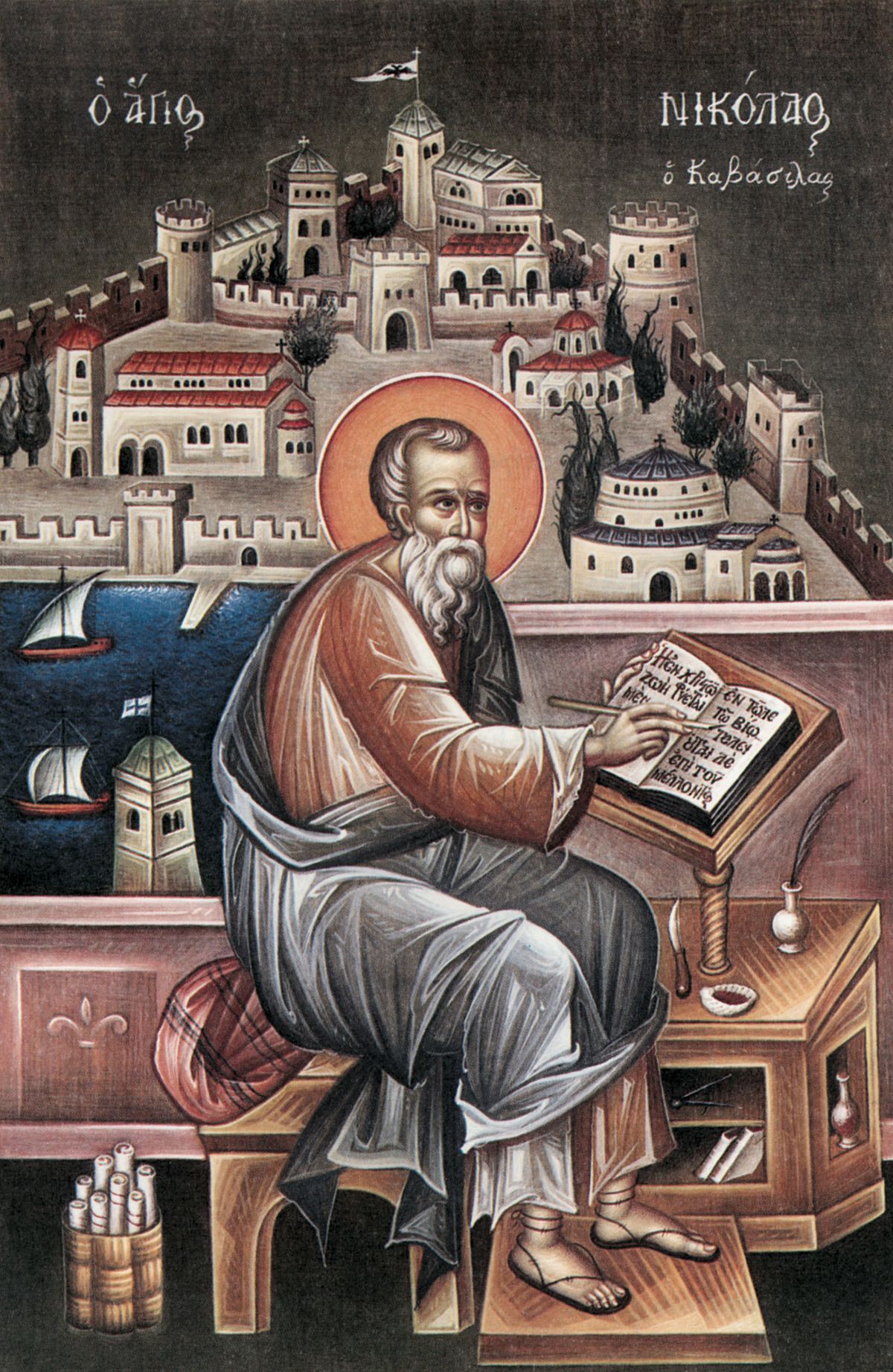
St. Nicholas Cabasilas: The fruits of the Sacraments


 We depart from this water [of Baptism] without sin. Because of the Chrism we partake of His graces, and because of the banquet [of the Holy Eucharist] we live with the same life as He does. in the world to come we shall be gods with God, fellow-heirs with Him of the same riches, reigning with Him in the same kingdom - that is, unless we of our own free will bling ourselves in this life and rend asunder the royal garment. This alone we contribute to the life - that we submit to His gifts, retain His grace, and do not reject the crown which God by many toils and labors has prepared for us.
+St. Nicholas Cabasilas, from The Life in Christ, book 1, #11.