Showing posts with label -St. Theophan the Recluse. Show all posts

Saturday, February 6, 2021

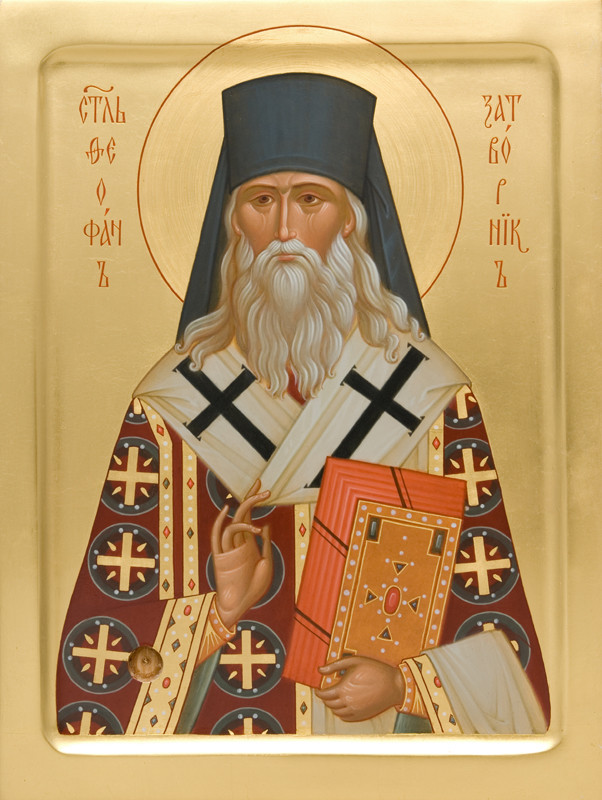
St. Theophan the Recluse: On Christian grief


 Although we must shed tears in our grief, let us do this in a Christian way, not as the heathen who have no hope. Let no word of complaint come from our lips, nor any feeling of despondency darken our hearts. To weep and grieve is a very human thing, but to give way to despondency and despair, complaint and criticism, is satanic. So let us dissolve grief in hope, so that a new warmth and tenderness will be born in our tears: this will not be the kind of weeping that burns and torments, but one that melts the heart and pours out comfort.
+St. Theophan the Recluse, from a sermon preached during a severe drought during his service as bishop of Tambov, quoted in The Heart of Salvation: The Life and Teachings of Saint Theophan the Recluse, Chapter 4 Theophan's Episcopacy 

Sunday, January 3, 2021

St. Theophan the Recluse: On seeing all things spiritually


 A cause of our distracted state is constantly seeing and listening to things that prevent recollection. If this is checked, inner peace will be undisturbed. Obviously, the quickest way to achieve this would be to shut off all feeling, but not everyone can or ought to do this. So the holy Fathers devised a salutary remedy: It is to direct your sensitivity towards the things of the spirit. This fortifies it instead of letting it become distracted. This is accomplished by giving spiritual significance to everything - to the point at which a glance at an object will not bring an awareness of the object itself but of its spiritual interpretation. Whoever does this with everything he meets will grow in understanding. Light and darkness, man an beast, stones and plants, houses and fields, everything from great to small will be a lesson for him, and how salutary this can be.
His pupils once asked a staretz why he wept when he saw a beautiful but heavily made up woman. "I weep", he replied, "at the destruction of God's intelligent creation, but also I weep because I have not so much zeal for the salvation of my soul as she has for the spoiling of her body." And another elder who heard a woman; mourning at a graveside remarked: "That is the way in which Christians should mourn over their own sins.
+St. Theophan the Recluse, quoted in The Heart of Salvation, The Life and Teachings of St. Theophan the Recluse, Chapter 2, Spiritual Vision

Monday, November 30, 2020

St. Theophan the Recluse: Begin each day as if it were the first


 First of all, do not ever think that you have already succeeded in doing something. Our weakness is that when some tiny good shows itself inside of us, we immediately cry out, "There, I've done it!" Drive out such thoughts. For good never comes easily and all at once as the adversary suggests. If you yield to this suggestion, you energy will immediately weaken, and then discord will be close again. So that you do not fall under this evil thought, each day, when you get up, put yourself in such a frame of mind as if you were beginning to labor on this path for the first time.
+St. Theophan the Recluse, from The Spiritual Life and how to be Attuned to It, #44 Warnings to one on the True Path

Thursday, October 15, 2020

St. Theophan the Recluse: The Fire of Zeal


 What success can one expect when there is no enthusiastic zeal for a Christian pleasing of God? If there is something that involves no labor, one is ready to do it; but as soon as one is required to do a little extra labor, or some kind of self-sacrifice, immediately one refuses, because one is unable to accomplish it oneself. For then there will be nothing to rely on that can move one to good deeds: self-pity will undermine all the foundations. And if any other motive besides the one mentioned becomes involved, it will make the good deed into a bad deed...
Zealous pleasing of God is the path to God which is full of consolation and gives wings to the spirit. Without it one can ruin everything.
One must to everything for the glory of God in defiance of the sin which dwells in us. Without this we will do everything only out of habit, because it seems "proper", because this is the way it has always been done, or the way others do it. We must do all we can, otherwise we will do some things and neglect others, and this without any contrition or even knowledge of what we have omitted. One must to everything with heedfulness and care, as our chief task; otherwise we will do everything just as it comes.
And so, it is clear that without zeal a Christian is a poor Christian. He is drowsy, feeble, lifeless, neither hot nor cold - and this kind of life is not life at all. Knowing this, let us strive to manifest ourselves as true zealots of good deeds, having neither stain nor spot, nor any of these things.
+St. Theophan the Recluse, from The Path to Salvation, Chapter 1, #2.

Tuesday, July 21, 2020

St. Theophan the Recluse: Preparing to pray

To transform our saying of prayers into a real education in prayer, they must be said in such a way that both heart and mind absorb their content. So that you may achieve this I will give you three simple instructions:
  • First, do not start to pray without at least some brief preparation.
  • Second, do not perform your prayer carelessly, but do so with attention and feeling.
  • Third, do not return to your usual occupations immediately [after] you have finished praying.
Although prayer is a habitual action for us, it needs preparation. For anyone who knows how to read and write, what is more usual than reading and writing? Yet if we sit down to read or write we do not do so suddenly, we first get ourselves into the mood for what we are going to do. This kind of preparation is all the more necessary before we start to pray, particularly if our occupation beforehand was very different from prayer.
So, morning or evening, immediately before you begin to repeat your prayers, stand awhile, sit for a while, or walk a little and try to steady your mind and turn it away from all worldly activities and objects. After this, think who He is to whom you turn in prayer, then recollect who you are; who it is who is about to start this invocation to Him in prayer. Do this in such a way as to wake in your heart a feeling of humility and reverent awe that you are standing in the presence of God.
All preparation for prayer consists in this reverent standing in the presence of God. To achieve this is a small task but one not to be ignored. It is the beginning of prayer, and a good beginning is half the complete task.
+St. Theophan the Recluse, from The Path of Prayer, Four Sermons on Prayer, the first sermon, A Personal Rule of Prayer

Friday, July 3, 2020

St. Theophan the Recluse: Always pray as if just beginning

You must never regard any spiritual work as firmly established, and this is especially true of prayer; but always pray as if beginning for the first time. When we do a thing for the first time, we come to it fresh and with a new-born enthusiasm. If, when starting to pray, you always approach it as though you had never yet prayed properly, and only now for the first time wished to do so, you will always pray with a fresh and lively zeal. And all will go well.
If you are not successful in your prayer, do not expect success in anything. It is the root of all.
+St. Theophan the Recluse, from What is Prayer? Chapter 2 in The Art of Prayer: An Orthodox Anthology, compiled by Igumen Chariton of Valamo.

Saturday, June 13, 2020

St. Theophan the Recluse: Unwavering zeal

As a straight thread is artfully spun by an industrious spinner, no matter how long she is at it, so also must be spun the thread of zeal of monastic life, from the moment you cross the threshold of the convent until the moment you cross the threshold of the door of the grave. Unwavering zeal has great significance, perhaps all significance. Have you ever seen a complicated machine that is brought into motion by steam? This is what occurs: when there is steam, the machine is in motion, and the more steam there is, the stronger the motion. When the steam weakens, then the motion also weakens; when the steam ceases, the motion also ceases. What steam is for a machine, zeal is for a God-pleasing life. When there is zeal, all labors go smoothly and any labor in not laborious. When there will be no zeal, there also will be no strength, no labor and no order; all becomes out of order then.
+St. Theophan the Recluse, from Kindling the Divine Spark, chapter 1, Keeping of the Monastic Vows.